
Automating a 200-person operation in two months, while supporting 46% growth
Fella: Forced to halt growth because of unscalable CX
In Q2 2026, Fella Health had surpassed $300m ARR and was serving more than 150,000 patients. Their Q3 goal was to double the business and expand into 3 new markets, but its customer experience operation couldn’t keep up.
An outsourced team of 200 people was handling 7,000 patient tickets a day. Supporting the planned growth would require another 200 staff at an additional cost of $2m a year, putting further pressure on an already strained training process.
Complex CX workflows depended on knowledge accumulated by experienced staff over years. The steps to follow, systems to check, and exceptions to handle were often undocumented, making new hires slow to train. Mistakes increased, and customer NPS fell by 30 points. That same knowledge gap made automation difficult: requests could not be automated reliably without first understanding how they were actually resolved.
With its CX team stretched thin, Fella had to pause its marketing and expansion plans. Resuming growth required turning scattered expertise into verifiable workflows that could be automated.
With Subliminal: 3 min/employee installations; workflows mapped in 2 weeks

Fella turned to Subliminal to accelerate its automation. Subliminal was installed across CX staff (3 mins/employee) and began learning how the different types of tickets are handled. No action was required from employees - Subliminal ran entirely in the background. Recordings were stored and processed in Fella’s own AWS account.
Within two weeks, Subliminal had mapped the workflows, revealing the steps employees followed, the systems they used, and the exceptions that required judgment. Across 1,088 hours of recorded work, three ticket types took 54% of the team’s time: delivery and order-status questions, dosage and medical questions, and refund and billing disputes.
This showed where automation would have the greatest impact and what each workflow had to handle, and identified 716 hours of work that could be fully automated. Automations went live on real tickets within three weeks of the first meeting.
Testing agents on real tickets, away from live systems
Subliminal also turned Fella’s recordings into a test environment, so the company’s own history became its benchmark. Models read the recordings, grouped tickets by kind and wrote a wiki of how the work is actually done: people and roles, systems, rules and thresholds, reply templates, and how past cases went. Every claim in the wiki links back to the recordings it was drawn from; none of it came from interviews.
Testing used a temporal holdout. The wiki was written from earlier weeks of recording only, and later tickets were held back, so nothing from a test ticket could leak into what the agent knew. For each held-out ticket, the agent saw what the employee could see when it arrived, with anything that revealed the employee’s answer withheld, and later patient messages arrived round by round. The agent worked the ticket through sandboxed copies of Fella’s tools, from patient replies and notes to refunds and order and subscription changes, so nothing touched Fella’s live systems.
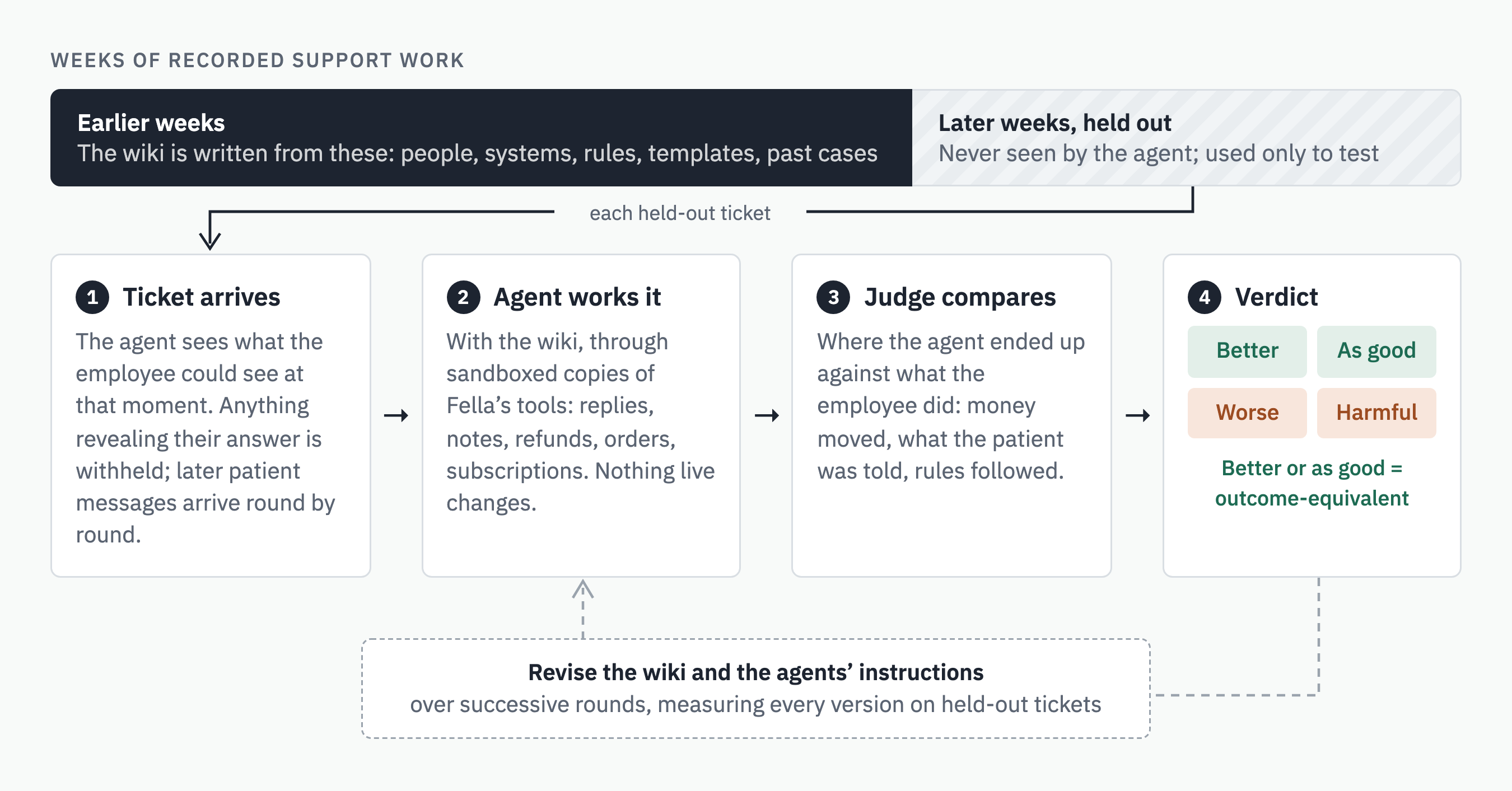
An agent rarely takes the same path as an employee, so each ticket was scored on outcome rather than a word-for-word match. A judge model compared where the two ended up, including what money moved, what the patient was told and which rules were followed, and rated the agent’s handling better, as good, worse or harmful. Better or as good counts as outcome-equivalent.
The judge was itself tested before it scored anything. Run twice on the same 74 cases, it gave the same verdict on 73. When a key action was removed from a case it had passed, such as a refund that was never issued, it failed every one, and harmless rewording of a reply still passed.
Subliminal then revised the wiki and the agents’ instructions and templates over successive rounds, measuring every version on held-out tickets the agents had never seen.
Surpassing 85% automation in 2 months
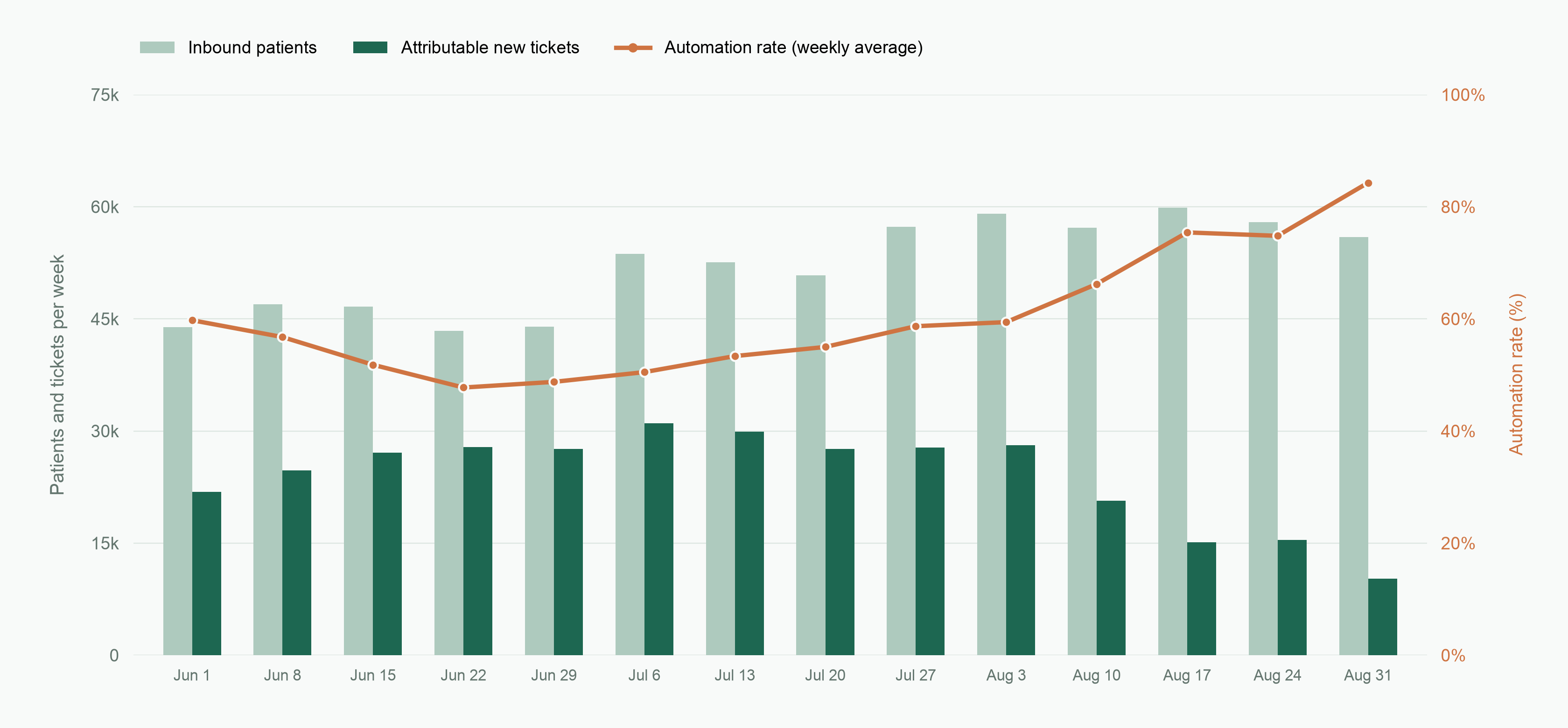
Thanks to Subliminal, Fella’s workflows are now 85% automated - the results are telling:
- Fella was able to resume expansion and grew revenue by 46% over the next two months, with no new hires.
- This would have previously required hiring 200 additional staff, amounting to $2m in annual incremental costs.
- Median end-to-end resolution time fell from 9 minutes to 2 minutes.
- Tickets needing a person fell from 7,000 a day to about 2,000.
- With routine requests handled automatically, staff had more time to train and give individual attention to patients with complex needs. Customer NPS rose by 30 points.
“Even the smallest insights are extremely helpful. We have a lot of leverage here.” — Head of Engineering, Fella Health
By making its CX workflows visible and actionable, Subliminal helped Fella remove a constraint on growth and build a support operation that could serve more patients with greater care.
Fella has since expanded Subliminal from its CX team to the rest of the company.